Disclosure: We are the team behind ViviDiary. This is a desk-researched comparison based on official documentation and our v1.5 preview, not an independent review. Sources were checked on 2026-10-26.
Scope Note: This comparison uses the ViviDiary v1.5 preview shown on our site; current store builds and subscription plans may differ. The v1.5 preview does not include AI conversation features.
Choosing between Finch and ViviDiary comes down to a structural difference in how your daily inputs are used. Finch directly links your real-world goals and reflections to the progression of a virtual pet. Completing tasks gives your pet energy to go on adventures, returning with stories and discoveries. ViviDiary takes a different approach, keeping your journal, routines, and pattern analytics entirely separate from its virtual companion. In the ViviDiary v1.5 preview, the Mochi character exists in its own space, reacting to touch but requiring no points, energy, or care tasks to function.
Feature Comparison
| Feature | Finch | ViviDiary v1.5 Preview |
|---|---|---|
| Core Mechanic | Goals provide energy for pet adventures | Independent journaling and routine tracking |
| Pet Progression | Pet grows, goes on adventures, discovers likes/dislikes | Mochi roams and reacts to touch; no growth or levels |
| Task Dependency | Pet requires task completion to adventure | Mochi space is entirely independent of tasks |
| Data Visualization | Goals/reflections and pet-profile history; reporting is not exhaustively evaluated here | Calendar, pattern analytics, and mood tracking |
| Routine Management | Goals and self-care activities | Dedicated routines and todos interface |
| Input Types | Goals, reflections, self-care activities | Five moods, emojis, notes, photos, audio |
| AI Features | Not evaluated in this brief | AI chat is absent from this preview |
The Energy and Adventure Loop in Finch
Finch is built around a core gameplay loop where your self-care directly fuels your pet. According to the Finch New User Guide, setting goals, completing reflections, and engaging in self-care activities provide the energy your pet needs to embark on adventures. This creates a direct dependency: if you do not log your habits or complete your goals, your pet cannot progress through its daily journey.
When the pet returns from an adventure, it brings back a story. The Finch Discoveries documentation notes that these adventures can produce likes and dislikes that are recorded in the pet's profile, though these discoveries are not guaranteed on every single adventure. This mechanic turns habit tracking into a narrative experience, where your real-world actions shape the personality and experiences of your virtual companion.
ViviDiary v1.5 Preview: Journaling First, Mochi Second
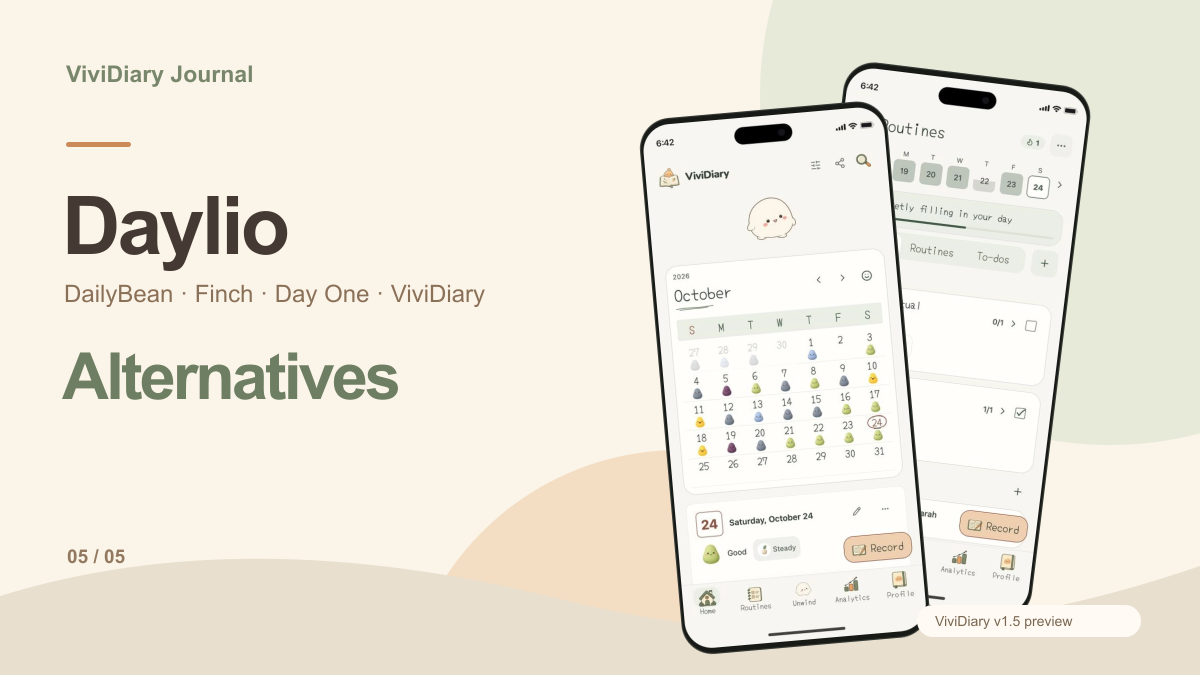
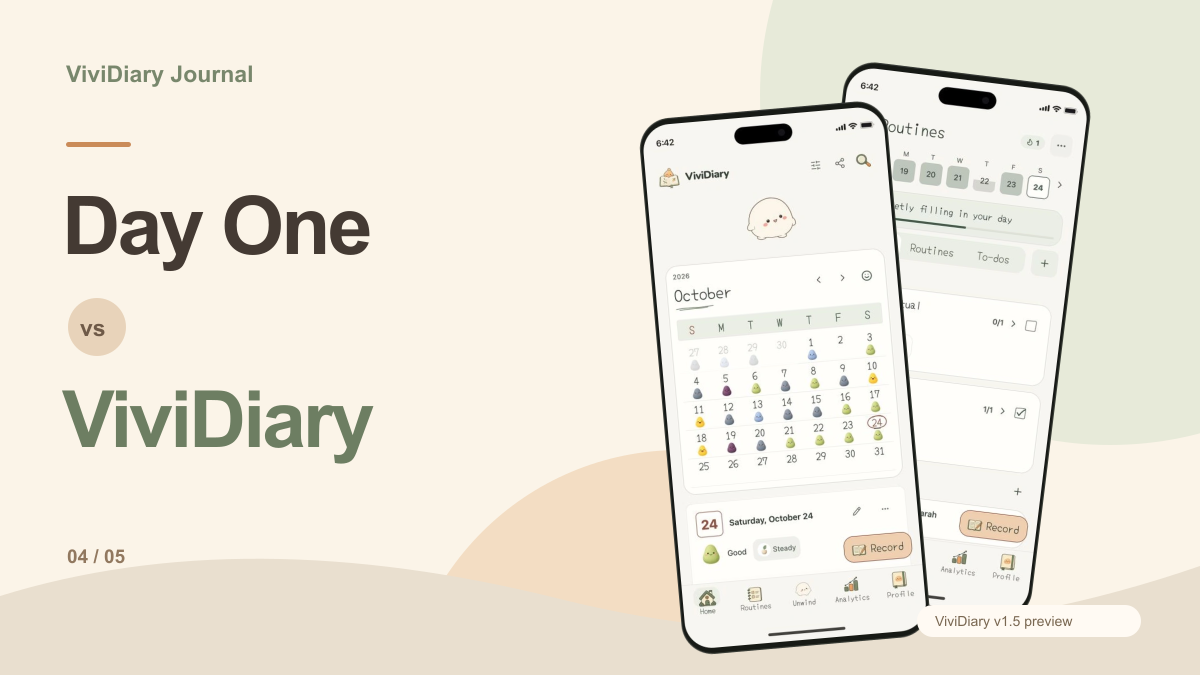
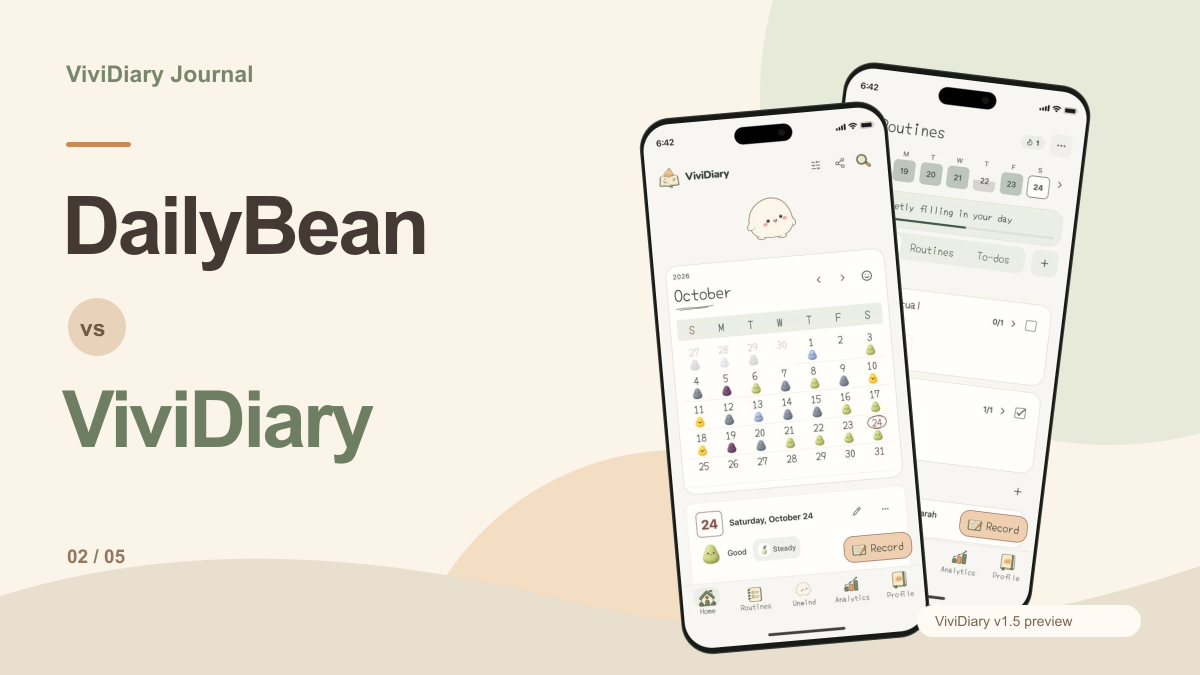
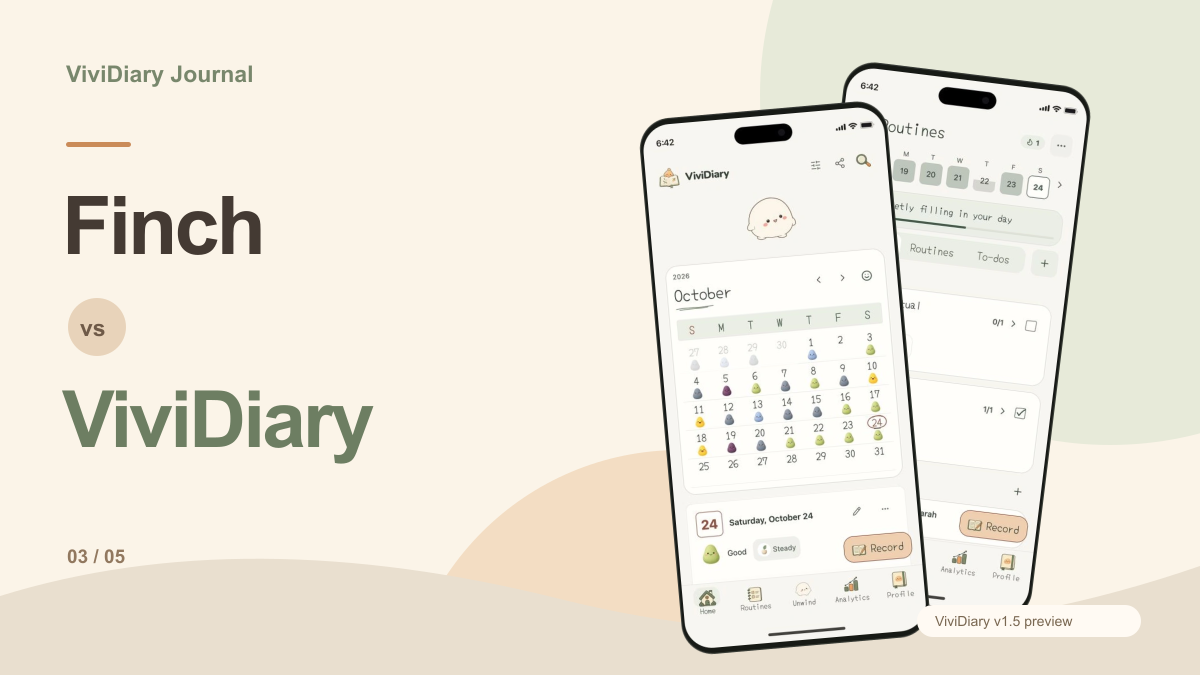
The ViviDiary v1.5 preview, as illustrated on ViviDiary website, takes a fundamentally different approach. The app is primarily a journal and routine tracker. You log your day using five moods, optional activity emojis, notes, photos, and audio. These inputs feed into a calendar and pattern analytics system designed to help you understand your own habits over time.
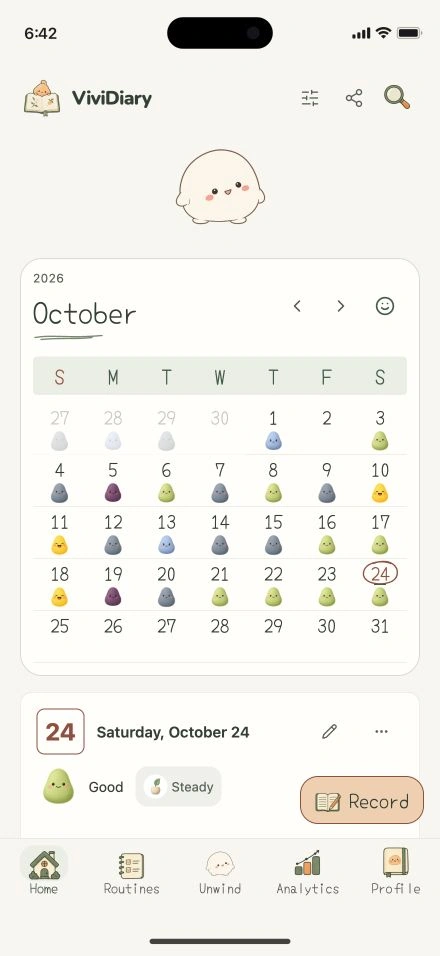
The virtual pet aspect, featuring the Mochi character, is completely decoupled from your journaling. Mochi roams near a leaf, rock, or flower and responds to touch, but there are absolutely no levels, points, or growth mechanics tied to your logging. You do not earn currency by completing routines, and Mochi does not go on adventures or require care tasks. This separation ensures that your primary focus remains on your own data, rather than maintaining a virtual pet's status.
When to Choose Finch
Finch is the clear choice if you are motivated by external progression and narrative rewards. If you struggle to complete daily tasks for your own sake, the mechanism of earning energy to send a pet on an adventure provides an immediate, tangible reason to check off a goal. The fact that the pet returns with a story and develops a profile of likes and dislikes adds a layer of attachment that many find highly motivating. For users who want their self-care to feel like a game with a living companion, Finch's integrated loop is highly effective. You might also want to read our Finch vs Daylio adults comparison 2026 for more context on how Finch stacks up against purely data-driven trackers.
When to Choose ViviDiary
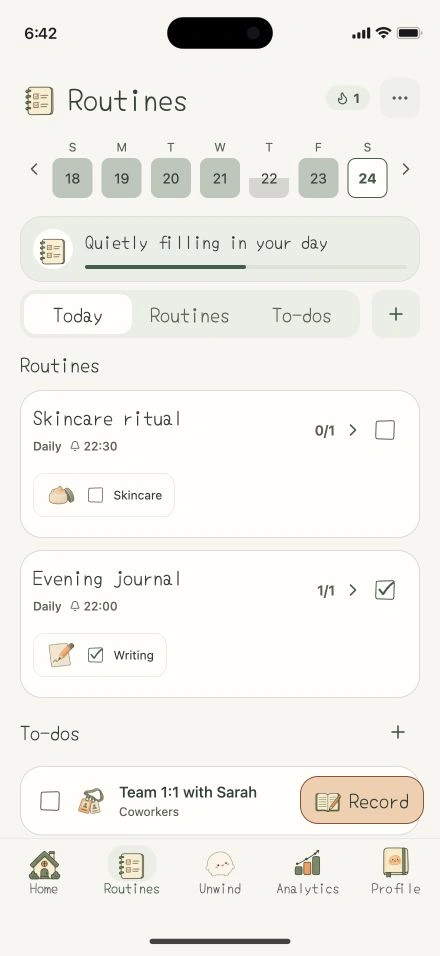
ViviDiary is designed for users who want to track their habits and moods without the pressure of maintaining a virtual pet's progression. If you prefer to see your own patterns through analytics and a structured calendar, rather than through a pet's narrative, ViviDiary's approach is more suitable. The inclusion of routines and todos allows for practical daily management, while the Mochi space offers a separate, optional interaction that does not demand your attention or penalize you for missing a day.
This decoupled design is particularly useful if you are utilizing specific journaling techniques, such as the scrap a day journaling method, where the focus is entirely on your own reflections rather than gamified rewards. If you are comparing other options, you can also review our thoughts on Daylio vs ViviDiary or DailyBean vs ViviDiary.
Evaluating a Week of Records
To determine which system works better for you, consider a hypothetical week of tracking. In Finch, a successful week means your pet has gone on several adventures, returned with stories, and perhaps discovered a new like or dislike. You evaluate your week by looking at your pet's progression and the energy you generated.
In the ViviDiary v1.5 preview, a successful week is evaluated by reviewing your mood calendar and pattern analytics. You look at the correlations between your five moods and the optional activity emojis you selected. You check your routines and todos interface to see which habits you maintained. The Mochi space remains exactly as it was—a standalone area for interaction, unaffected by whether you logged every day or missed a few. If you are ready to test this approach, you can download ViviDiary to see the current public build.
Proposed Evaluation: Testing Your Logging Preferences
Assessing the Impact of Several Entries
To determine which application aligns with your daily habits, consider this proposed evaluation rather than relying on a single day of use. Commit to logging your activities and reflections for a continuous period to observe how each application processes your data. In Finch, your primary focus during this evaluation is the energy and adventure loop. As you input your goals, reflections, and self-care activities, monitor how these actions generate energy. Once sufficient energy is accumulated, send your pet on an adventure. The critical evaluation point occurs when the pet returns. Read the returning story and check the pet’s profile to see if a discovery resulted in a new recorded like or dislike. Because these specific discovery outcomes are not guaranteed on every adventure, evaluate whether the anticipation of these stories sustains your interest in logging over multiple days.
For the ViviDiary v1.5 preview, the evaluation process shifts entirely away from energy generation. Input your data using the five available moods, and attach optional activity emojis, text notes, photos, or audio recordings. After logging several entries, navigate to the calendar and the pattern analytics sections. Assess whether reviewing your routines, to-dos, and mood patterns in a direct, analytical format provides the utility you require. The goal of this proposed evaluation is to identify whether you respond better to data presented as a narrative adventure or as structured personal analytics.
Distinguishing Core Utility from Decoration
A crucial step in this proposed evaluation is separating the features that actively drive your daily use from those that are merely decorative. In Finch, the virtual pet is not a decorative add-on; it is the core utility of the application. The entire system is built on a dependent loop: your real-world goals and self-care activities directly fund the pet’s ability to explore. The feedback you receive—the returning stories and the evolving profile of likes and dislikes—is the primary mechanism designed to encourage continued use.
In contrast, the ViviDiary v1.5 preview treats its virtual companion as a separate, optional feature rather than the core engine of the application. The primary utility lies in the journal-first calendar, the routine tracking, and the pattern analytics. The Mochi space exists independently. You can observe Mochi wandering near a leaf, rock, or flower, or hiding, and it will respond to touch. However, interacting with Mochi or logging journal entries does not yield points, currency, or levels. There is absolutely no growth coupling, no care tasks, no AI chat, and no adventure mechanics. When evaluating the two, you must decide if you need the pet to be the structural center of your logging habits, or if you prefer a standalone journal where the interactive Mochi is an independent interactive space you can visit separately.
Preserving Records and Justifying a Switch
Before moving, inspect your existing app’s current backup and export options. Backing up a diary and importing it into another app are separate capabilities: one does not prove the other. Keep the original archive and check that a sample backup can actually be read before changing your setup. This comparison does not verify automatic migration into ViviDiary. You can evaluate new entries without deleting your earlier records, and your existing app can remain a reference archive if the new app does not accept its file format.
Ultimately, you must determine what specific factors justify staying with your current application instead of making a switch. If you currently use Finch, remaining with the application is justified if the interconnected loop of goals, energy, and adventures remains your primary catalyst for completing self-care activities. If the anticipation of the pet’s returning story and the gradual discovery of its likes and dislikes are what prompt you to open the application daily, switching to a non-gamified system may disrupt your established habits.
Conversely, a switch to the ViviDiary v1.5 preview is justified if your priorities have shifted toward direct data analysis. If you require a journal-first approach where calendar views, routines, and pattern analytics take precedence over virtual companion progression, this model fits your needs. Choosing ViviDiary is appropriate if you specifically want to log moods, photos, and audio without those actions being tied to pet growth, levels, or currency, while still having access to the separate, optional Mochi space.
Practical Limitations
The pet loop is a major reason to choose Finch, but it is not the only function in the app. Its official guide also documents reflections, breathing exercises and focus timers. If adventures do not appeal to you, assess those tools directly rather than assuming the rest of Finch has no value. The question is whether its particular mix of tools and character progression earns a place in your day. That is an individual preference, not a claim about psychological effectiveness.
ViviDiary's limitation lies in its strict separation of features. Because there are no points, levels, or growth mechanics tied to your journaling, users who need gamified incentives to build habits may find the app lacking in immediate rewards. Furthermore, as noted in the scope, the v1.5 preview does not include AI chat, and current store builds may differ from the preview described here. Users looking for a more traditional diary experience might also explore our Day One vs ViviDiary comparison.