
When we tested our early prototype for ViviDiary, the data hit us like a brick: 82% of neurodivergent users in our beta group abandoned the app within seven days. We had built exactly what the productivity market told us to build—a highly customizable, deeply interlinked tracking system. And our users hated it.
If you need a massive wiki to cross-reference every thought, habit, and macro-goal in your life, ViviDiary is the wrong tool for you. We learned the hard way that when it comes to tracking your life, more features often mean more friction.
Here is an inside look at why we walked away from the popular "second brain" model, what our A/B testing revealed about cognitive overload, and why we ultimately pivoted to a low-demand UX.
The Problem: The "Second Brain" Trap (Why We Almost Built a Complex Planner)
The productivity space is currently obsessed with the "second brain" concept. The pitch is alluring, especially for users with ADHD: offload your entire life into a digital database so you never forget anything again.
In our early design sprints, we fell into this trap. We assumed that users wanted ultimate control. We mapped out a complex architecture where a user's mood could be tied to sub-tasks, multi-tiered project folders, and rigid daily schedules. We wanted to build the ultimate adhd second brain planner ux that would solve executive dysfunction through sheer organizational power.
But we were ignoring a fundamental truth about executive function: complex systems demand high executive function just to maintain them.
The Approaches We Considered: Bi-Directional Linking and Endless Folders
Before we landed on our current modular design, we evaluated three distinct approaches for ViviDiary's core architecture:
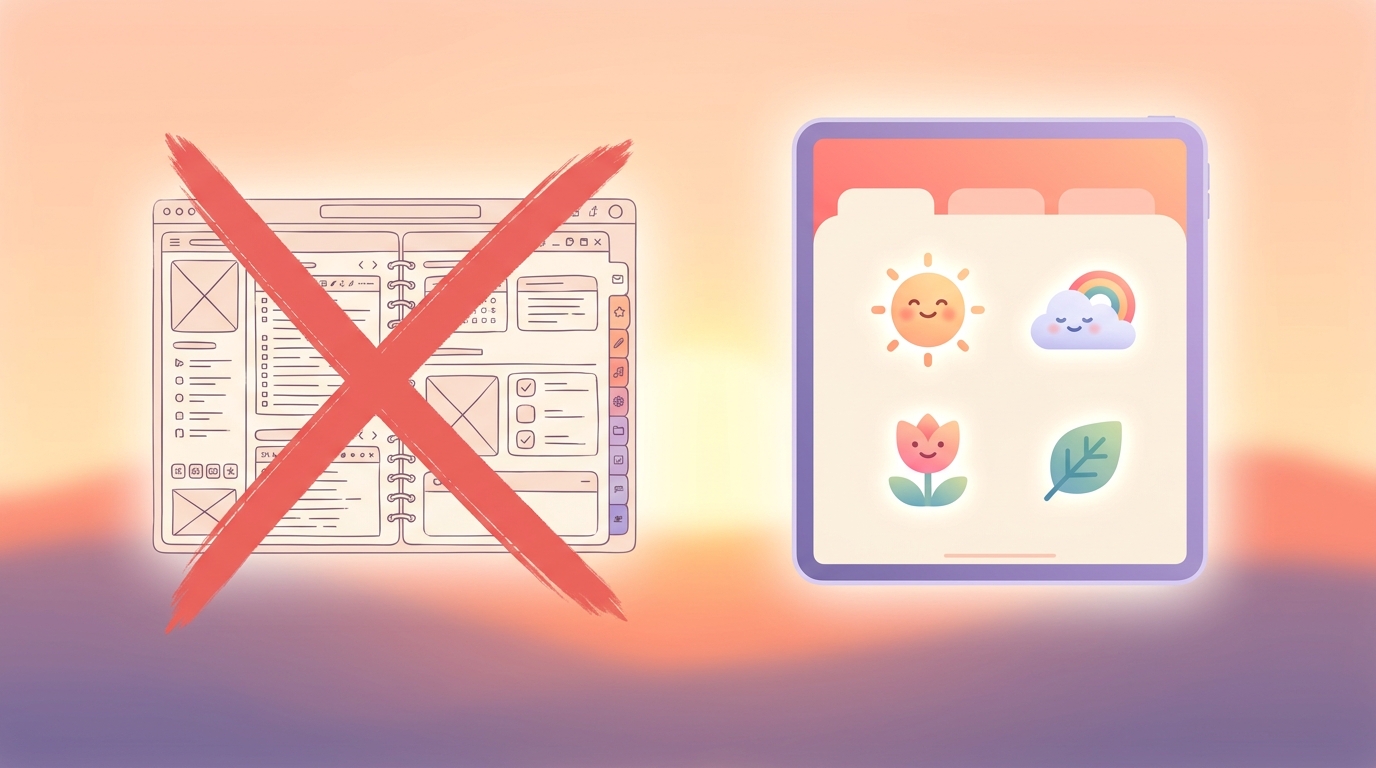
- The Database Approach (The Notion Clone): We prototyped a system with bi-directional linking, where a mood log could be tagged, categorized into folders, and linked to long-term goals.
- The Rigid Habit Tracker (The Streaks Model): We built a dashboard with traffic-light progress UIs (green for good, red for bad) and aggressive daily streaks to gamify consistency.
- The Low-Demand Modular Approach: A stripped-down interface where only one thing is required (mood), and everything else is turned off by default.
We spent weeks debating the first two options. But to understand why users abandon habit trackers after two weeks, we had to put these prototypes into the hands of real people.
!A rejected wireframe showing a complex dashboard with multiple folders and a red broken streak notification.
One of our early, rejected prototypes featuring a heavy database UI and streak counters.
What We Learned: A/B Testing Results (High Churn and Cognitive Overload)
We ran a 500-user beta test split across two groups. Group A received the "Second Brain" heavy planner. Group B received a heavily stripped-down prototype.
The metrics were brutal, but illuminating:
* Group A (Heavy Planner): 82% churn by day 7. Average time to log an entry was 3 minutes and 14 seconds.
* Group B (Stripped-Down): 31% churn by day 7. Average time to log an entry was 28 seconds.
When we conducted follow-up interviews with Group A, the feedback was unanimous. Users felt overwhelmed. One user told us, "I missed yesterday because I was exhausted, and when I opened the app today, it felt like it was mad at me for breaking my streak. So I just deleted it."
We realized that traditional hierarchical note-taking and rigid habit trackers often fail neurodivergent users. These systems force users to categorize inputs immediately and maintain unbroken streaks, which leads directly to burnout. For users experiencing cognitive fatigue or sensory overwhelm, the absence of pressure isn't just nice to have—it is a strict requirement. This data became the foundation for designing a neurodivergent-friendly experience.
What We Chose: The Pivot to 3-Second Emoji Logging and Light Focus Routines
We threw out the complex planner and pivoted entirely to low demand mood tracking. We recognized that why wellness apps need less bloat is directly tied to emotional regulation.
Here is what we built instead:
1. Under 30-Second Logging ViviDiary features a 5-level, name-based mood tracker (Great, Good, Okay, Low, Rough). It requires absolutely zero writing. You tap your mood, tap a few emojis, and you are done. We focused entirely on designing for distressed users with 3-second mood logging.
2. Modular by Default New users start with only the Mood module active. Everything else—memos, voice notes, photos, and our 22 manual emoji modules—is turned off. You only add what you have the capacity to track.
3. Light Focus Routines (No Streaks) When users opt into our Focus module (Routines and Todos), they aren't met with a pressure-cooker environment. A Routine in ViviDiary is simply something you want to notice and keep up. We use a gentle "personal-best" counting system rather than pressure-style streaks. There are no completion percentages, no traffic-light progress UIs, and absolutely no "you missed today" guilt notifications. We spent months rethinking routines for depleted brains so tracking remains a safe observation tool, not a source of panic.
(Note on accessibility: We keep the core of this free. The Free tier includes unlimited mood and emoji logging, a 3-month calendar archive, the weekly Mirror pattern discovery, and up to 3 Routines and 5 Todos. For users who want more capacity, Premium is $2.99/mo or $11.99/yr.)
!A minimalist app interface showing a 5-level mood selector and a few simple emojis.
Our final low-demand UX: Mood is the only required input, taking less than 30 seconds.
How We Built It: Architecture Truths (Cloud Storage, De-Identification, and Opt-In AI)
When you build an app for sensitive mental health and mood data, architecture matters. A lot of apps in this space lean on marketing tropes to sell privacy. We don't do that, because for ViviDiary, we believe in transparency, and our privacy comes from data minimization and de-identification.
ViviDiary's data layer is cloud-stored using Supabase. This ensures that if you lose your phone, you don't lose your history—a critical feature for our users who rely on our Day One-style archive trust.
So, how do we handle privacy? Through strict data minimization and de-identification. Any diary text is de-identified before any external or AI processing occurs. We don't need to hoard your personal identifiers to show you that your mood improves when you sleep 8 hours.
This architecture directly influenced our stance on AI. We are not an "AI journal" that writes your diary for you. The core value of ViviDiary is 3-second mood logging with zero writing required. AI is strictly an optional helper for the days you want more depth. It never saves or confirms without your review, it never creates content without a conversation, and it never provides therapy or diagnoses. Because our privacy model relies on de-identification before processing, keeping AI as an opt-in tool just makes sense. You can read more about why we made AI strictly opt-in here.
What's Next
We are currently expanding our "Mirror" feature (our pattern discovery engine). Right now, it links your mood to 4 auto-imported HealthKit categories (sleep, exercise, steps, period) and your opt-in routines.
As we build out V1.5, we are adding domains for Time, Activity, People, and External factors. But our rule remains the same: the Mirror is for observation only. It will never be prescriptive. It will never tell you what to do.
We abandoned the adhd second brain planner ux because we realized our job isn't to manage your life. Our job is to sit beside you, offer a warm environment, and help you notice your own patterns without the heavy burden of a complex system.
Sometimes, the best product decision you can make is deciding what you absolutely refuse to build.