
78% of our users log their final mood of the day between 9:30 PM and 11:30 PM. When you own that specific slice of a user's day, you have a massive responsibility not to ruin their sleep.
In early 2026, a massive shift happened in how people spend their final waking hours. The "bedtime stacking" trend took over social media, encouraging users to bring their entire evening routine—journaling, skincare, laptops, supplements, and snacks—directly into bed. It was framed as the ultimate cozy productivity hack.
Naturally, the pressure was on for us to build features that catered to this. Users were asking for complex, multi-step evening checklists. Investors were pointing to engagement metrics from competitors who were gamifying the wind-down process.
We looked at the data, built a prototype, and then we killed it.
Here is the story of why we explicitly designed against the bedtime stacking tiktok trend 2026, what we built instead, and how we keep our app from turning your bed into a high-pressure command center.
The Feature Request: Capitalizing on the Bedtime Stacking TikTok Trend
If you spent any time on social media earlier this year, you saw it. Influencers propped up against their headboards with a lap desk, a glowing tablet, three different physical journals (one for gratitude, one for shadow work, one for scheduling), a 5-step skincare caddy, and a cup of magnesium tea.
The logic behind bedtime stacking feels sound at first glance: if you are too tired to do your self-care routines around the house, just do them in bed.
From a product management perspective, this trend was a goldmine for engagement. Habit tracking apps were suddenly releasing massive "Evening Wind-Down Hubs." The standard bedtime routine app ux was shifting from a simple alarm to a 45-minute interactive checklist that users were supposed to tap through while under the covers.
Our initial feature request board lit up. Users wanted us to expand our Focus module to support 15-item nighttime checklists with built-in timers. They wanted progress bars for their evening routines. They wanted us to build a system that would guide them through a stacked bedtime ritual.
What We Rejected: The 45-Minute "Evening Wind-Down Hub"
We actually built a prototype of this. We called it the "Nightstand Hub."
In this internal build, when it hit 9:00 PM, ViviDiary would shift into a dedicated evening mode. It prompted you with a multi-step checklist: Did you drink water? Did you reflect on your goals? Did you plan tomorrow? Write three things you are grateful for.
It featured a circular progress ring that filled up as you completed your bedtime stack. If you finished it three days in a row, you got a little flame icon—a streak.
We ran a two-week internal test with our team and a small beta group. The results were disastrous.
- It created "productivity insomnia." Beta testers reported feeling wide awake after completing the hub. Instead of winding down, their brains were actively engaged in task completion and goal-setting.
- The guilt was immediate. If a user was exhausted and just wanted to sleep, seeing a 10-step checklist with a 0% completion ring made them feel like they were failing at resting.
- It bloated the app. We had spent months killing bloated dashboards to keep ViviDiary light. The Nightstand Hub completely reversed that philosophy.
We realized we were falling into the same trap as every other app on the market. We were weaponizing rest. By adding streaks and progress rings to sleep preparation, we were violating the core principles of anti addictive design in habit trackers august 2026.
We scrapped the prototype entirely.
The Sleep Hygiene Data That Killed the Feature
Beyond our own beta tests, we consulted the clinical data on sleep hygiene. Sleep experts were already sounding the alarm on bedtime stacking, calling it a massive "insomnia trap."
Cognitive behavioral therapy for insomnia (CBT-I) relies heavily on a concept called stimulus control. The core rule is simple: the bed is for sleep (and sex). That's it. When you bring laptops, journals, and elaborate routines into bed, you break the brain's association between the mattress and sleep. Your brain starts to view the bed as a place for work, reflection, and entertainment.
We had already seen how elaborate routines spike anxiety in the mornings. Doing it at night was even worse. By encouraging users to spend 45 minutes tapping through a wellness checklist in bed, we would be actively contributing to their sleep degradation.
We realized that a responsible wellness app shouldn't try to maximize your screen time at 10:30 PM. It should get you off your phone as fast as possible.
Designing for De-escalation: 3-Second Emoji Logging
Instead of building a heavy bedtime stacking hub, we doubled down on de-escalation. We wanted ViviDiary to be the absolute lightest touchpoint of your day.
The Core Input: Mood First We kept ViviDiary's default state radically simple. When a new user opens the app, only the Mood module is turned ON. Everything else is OFF by default.
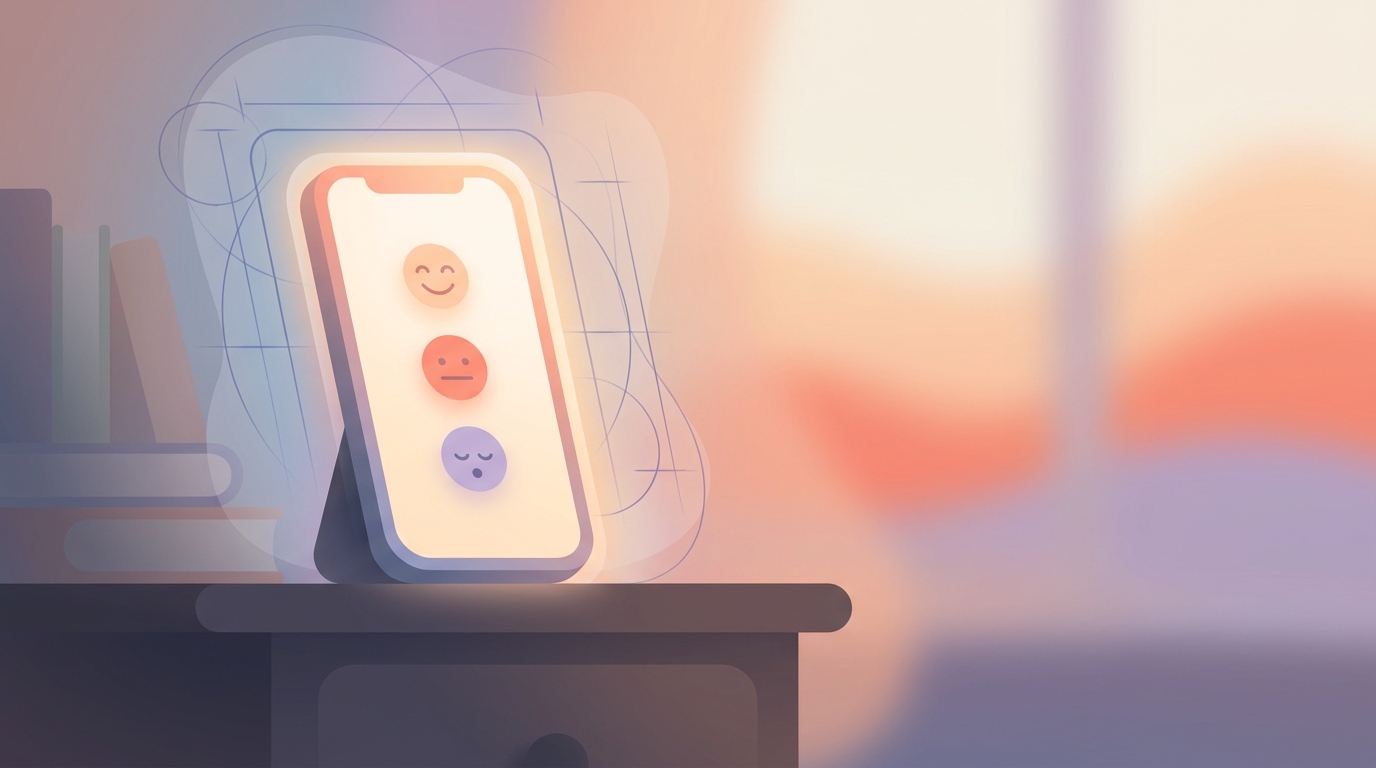
We rely on 3-second mood logging. You select your mood from our 5-level scale (Great, Good, Okay, Low, Rough), tap an energy level, pick a few emojis, and you are done. There is zero writing required. You don't have to stare at a blinking cursor while your eyes are heavy. You log it, and you go to sleep.
Reimagining the Focus Module We still wanted to support users who wanted to track their evening habits, but we needed to do it without the pressure.
We designed our light Focus routines to be exactly that—light. In ViviDiary, Focus consists of Routines and Todos.
* Routines are things you want to notice and keep up (like "Reading" or "Skincare"). They are linked to emoji categories. When you log the 📚 emoji, ViviDiary auto-counts it toward your reading routine.
* Todos are simple, per-day items you strike through when done.
Crucially, we stripped out all the anxiety-inducing mechanics. There are no pressure-style streaks. There is no "streak freeze" to buy, no broken-streak guilt, no completion percentages, and absolutely no "you missed today" push notifications. Routines keep a gentle personal-best count. If you miss a day, the app doesn't care. We don't care. You shouldn't either.
(Note on access: On our Free tier, users get up to 3 Routines and 5 Todos, unlimited mood/emoji logging, and a 3-month calendar archive. Our Premium tier is $2.99/mo or $11.99/yr for unlimited modules. We don't lock your core data behind a paywall.)
By keeping the friction this low, we noticed a massive drop in wellness app fatigue. Users were actually sticking with ViviDiary because it didn't demand a 45-minute performance every night.
Cloud Architecture, De-identification, and Keeping AI Opt-In
Part of the bedtime stacking trend involves deep, prompted journaling. Many apps are pushing AI heavily here, automatically generating summaries of your day or acting as a late-night therapist.
We took a different path.
First, let's talk about how we handle your data, because privacy is the bedrock of a diary app. We protect your information through strict data minimization and by ensuring your diary text is completely de-identified before any external processing. For ViviDiary, your data is safely cloud-stored, and we will always be transparent about it.
ViviDiary's data layer is cloud-stored using Supabase. We chose a cloud architecture because users demand seamless syncing across their iOS and Android devices, and they want the security of knowing their archive (like Day One) isn't lost if they drop their phone in a lake.
So, how do we protect your most intimate late-night thoughts? Privacy comes from data minimization and de-identification. Before any diary text is processed by external services or our AI features, it is strictly de-identified. We strip the metadata that links the text to your identity. We rely on robust cloud security and strict data minimization protocols.
This architecture directly influenced how we built our AI. We made AI opt-in for a very specific reason. The core value of ViviDiary is the 3-second mood and emoji log. AI is just an optional supporting tool for the days you actually want to write more deeply.
If you are lying in bed, exhausted, you don't want an AI coach popping up to ask you probing questions about your "Low" mood. The AI does not create content without a conversation, it does not save anything without your review, and it never provides prescriptive therapy. It sits beside you, warmly, only when you ask it to.
What We Learned
When we launched the updated, ultra-light Focus module instead of the heavy Nightstand Hub, we watched our retention metrics closely.
We expected a slight dip in daily session length (since users weren't spending 15 minutes checking off boxes). We did see that dip—average evening session time dropped from 2.5 minutes to 42 seconds.
But our 30-day retention increased by 14%.
Users were coming back more consistently because the app was no longer a burden. By designing against the bedtime stacking trend, we built a product that actually respects a user's need to rest.
Your bed is for sleep. Your diary should take 3 seconds. Leave the 10-step productivity routines for the morning—or better yet, drop them entirely.