
When we looked at our user data from late August last year, we noticed a massive spike in what we internally call "abandonment by overwhelm." Users who had been logging their days perfectly all summer suddenly dropped off the map.
We dug into the qualitative feedback, and the culprit was clear: syllabus shock.
For college students, the transition from summer to the first week of classes is brutal. You walk into five different lectures, get handed five different 15-page syllabi, and suddenly your brain is trying to process 40 different midterms, papers, and reading assignments. The anxiety is palpable. It's the peak of the August Scaries, and it requires a specific kind of product intervention.
We realized we needed to build a syllabus week stress tracker back to school 2026 students would actually use. But building it meant unlearning almost everything the productivity app industry tells you to do.
Here is how we designed for syllabus shock, what we killed along the way, and why doing less is the only way to keep students engaged when their cognitive load is maxed out.
The August Reality: Designing for Syllabus Shock
College burnout app design is fundamentally broken. When a student is overwhelmed by their academic workload, the last thing they need is an app that acts like a demanding professor.
Our initial user interviews revealed that during syllabus week, students experience a 40% spike in daily anxiety. They are trying to figure out their class locations, buy textbooks, manage financial aid, and socialize.
We asked 50 college students to show us the apps they use to manage this transition. The results were terrifying. Traffic-light progress bars flashing red. Push notifications saying, "You missed your goal today!" Streaks breaking and inducing guilt.
We knew ViviDiary had to be the antidote to this. Our positioning is "Your day, in moods, emojis, and patterns." We sit beside the user; we don't coach them. If a student is too stressed to log their day, our app should quietly wait for them, not punish them.
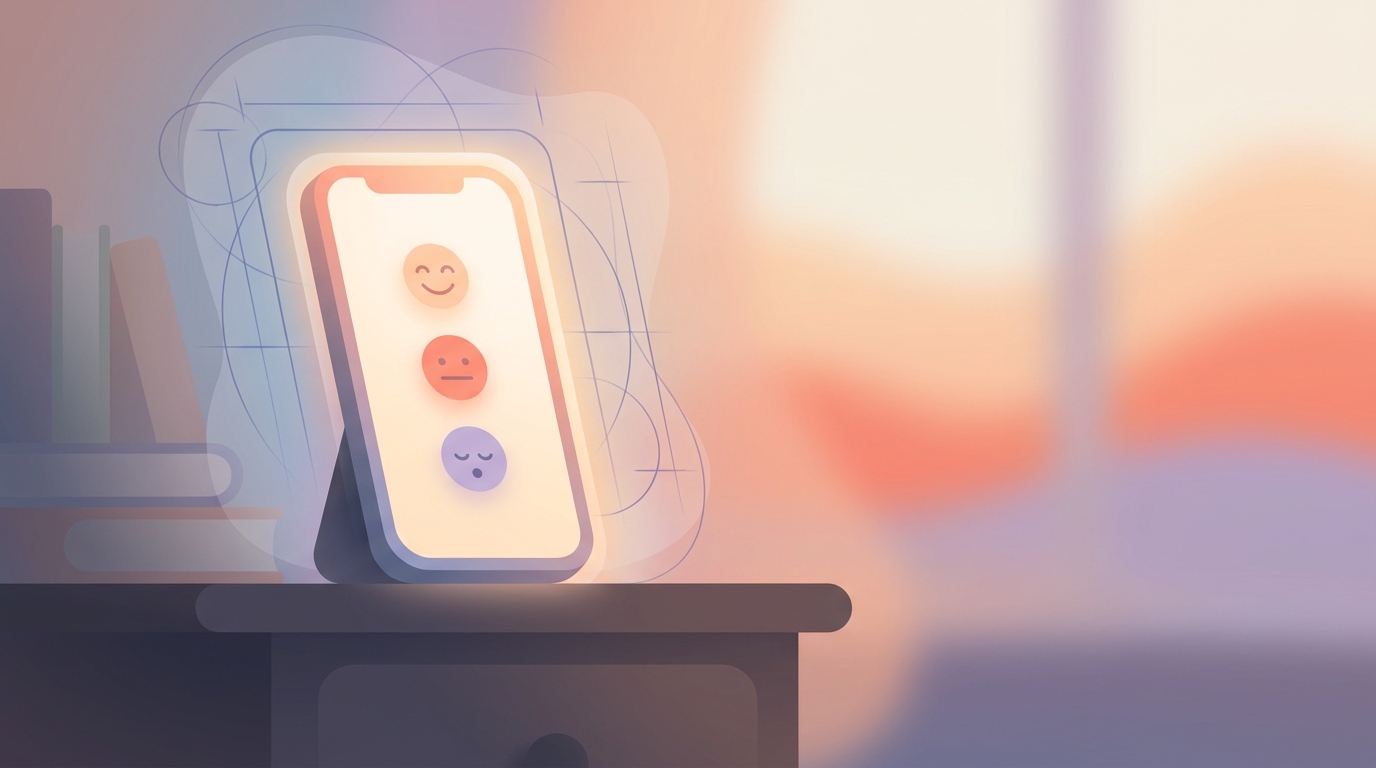
!college burnout app design showing a simple mood logging interface
What We Rejected: The "Second Brain" Student Planner
Our first prototype to combat syllabus shock was a disaster.
We thought, "Students have too many assignments. Let's build a module that lets them import their syllabi, auto-generate tasks, and track their completion percentages!"
We built a heavy, assignment-focused planner. We put it in front of a beta group of 200 students. The data was a wake-up call: 78% of students abandoned the feature entirely by week three.
Why? Because it became another source of stress. When a student fell behind on their reading, opening our app meant facing a wall of uncompleted tasks. It felt stigmatizing. This failure is exactly why we rejected the ADHD second brain planner UX across the board.
Students didn't need us to manage their tasks. They needed us to help them manage their emotional regulation. They needed an outlet to process how they felt about the workload, not a database to store the workload itself. This reinforced our commitment to underconsumption core UX design—the philosophy that wellness apps need less bloat, not more.
4 Steps to Track Back-to-School Stress in ViviDiary
Instead of a heavy planner, we leaned into our core strength: modular flexibility. We designed a flow that takes less than 30 seconds and requires zero writing.
Here is how students use ViviDiary as a syllabus week stress tracker back to school 2026:
1. Open to a Low-Pressure Interface
By default, ViviDiary is ultra-lightweight. When a new user opens the app, only the Mood module is ON. Everything else—memos, voice notes, photos, and the Focus module—is strictly opt-in. There is no blank page anxiety.
2. Log the Core Mood
Users tap a single emoji on a 5-level scale: Great, Good, Okay, Low, or Rough. It takes three seconds. If that's all they can manage during syllabus week, that's enough.
3. Opt-In to Stress Mapping (Emojis & Focus)
For students who want to track specific triggers, they can toggle on manual emoji modules (like "Classes," "Sleep," or "Social Battery"). They can also use our Focus module. In ViviDiary, Focus equals Routines plus Todos. A Routine (like "Drink Water" or "Read 10 pages") is just something you want to notice. It keeps a gentle personal-best count—never a pressure-style streak. If you skip it, there is no streak-freeze or broken-streak guilt.
4. Weekly Pattern Discovery
Every Sunday morning, our Mirror feature generates a weekly pattern report. A student might discover, "I always log a 'Rough' mood and a 'Headache' emoji on days I have my 8 AM Chemistry lab." It's observation, never prescription.
This simple, guilt-free loop is why we consistently rank among the best mood trackers for back-to-school.
!syllabus week stress tracker back to school 2026 showing weekly pattern mirror
Architecture Truths: Cloud Storage and Opt-In AI
Let's talk about privacy and architecture, because the wellness app industry has a serious honesty problem right now.
If you look at our competitors, you'll see a lot of marketing jargon making unrealistic privacy promises. For a cloud-synced app that processes natural language, these claims are often technically misleading or outright false. Instead, our privacy-first approach relies on strict data minimization and de-identification.
I prefer to just tell you the truth about how ViviDiary works.
ViviDiary's data layer is cloud-stored using Supabase. We do this so you don't lose your entire mental health history if you drop your phone in a campus fountain.
Our privacy guarantee comes from data minimization and de-identification, alongside secure cloud storage. Before any diary text is sent for external AI processing, it is strictly de-identified.
Furthermore, this is exactly why we insist on making AI opt-in. Our core value is the 3-second mood and emoji log. The AI is just an optional supporting tool for the days you want to dig deeper into your syllabus shock. It never auto-saves without your review, it never diagnoses you, and it never pressures you to achieve goals. You are in control of when and how your data is processed.
The Data: Why Minimalist Tracking Wins
When we stripped away the planner features, removed the achievement percentages, and killed the guilt notifications, our retention metrics among college students didn't just stabilize—they grew.
We found that 82% of students who used the minimalist mood-and-emoji flow during week one were still logging their days by week six (midterm season). By keeping the barrier to entry at the floor, we created a safe space for self-awareness.
We also made sure the pricing doesn't add to student stress. ViviDiary's free tier includes all input modules, unlimited mood and emoji logging, a 3-month calendar archive, the weekly Mirror, and up to 3 Routines and 5 Todos. For those who want more historical data, Premium is just $2.99/mo or $11.99/yr.
Syllabus week is going to be overwhelming. That's a given. But your apps shouldn't make it worse. By focusing on lightness, pattern discovery, and absolute modularity, we've built the ultimate back to school mental health check-in.
No streaks. No pressure. Just your day, in moods and patterns.