

Quick Verdict
If you are looking for the best finch app alternatives for adults in 2026, the right choice depends entirely on your tolerance for gamification. Choose ViviDiary if you want a modular, low-demand tracker that replaces pressure with gentle pattern discovery. Opt for Daylio for lightning-fast micro-journaling, or How We Feel for deep, research-backed emotional granularity. If you actually want more gamification but with a mature, high-stakes RPG twist, Habitica is your best bet.
---

The Virtual Pet Fatigue: Why Adults Outgrow Finch
Finch is a phenomenon for a reason. Its gentle approach to self-care—where completing real-world habits hatches and raises a virtual bird—has helped millions build routines. But I test productivity tools for a living, and over the last year, a distinct pattern has emerged in my inbox: virtual pet fatigue.
Recent discussions across the productivity space highlight a growing shift. Many adults eventually find the pet mechanic slightly too juvenile, or worse, they become overwhelmed by the app's in-game economy. When you are managing a real-world mortgage, managing a digital currency to buy virtual hats for a cartoon bird can suddenly feel like a second job.
Furthermore, at $39.99/year for Finch Plus, users who are ready for serious habit tracking often hit a ceiling. They start searching for apps like finch but simpler—tools that retain the frictionless check-in but drop the chore of digital pet maintenance.
If you want to step away from the gamified grind, you need an app that respects your time and cognitive load. We recently ranked the top mood tracker apps, and below, we are diving deep into the specific trackers that serve as the best graduation points from Finch.
Feature Comparison Table: The Top Alternatives
I am a firm believer that you shouldn't have to read 2,000 words to find out if an app fits your budget. Here is the head-to-head data.
| Feature / App | ViviDiary | Daylio | How We Feel | Habitica |
|---|---|---|---|---|
| Best For | Low-demand, modular tracking | Fast micro-journaling | Emotional granularity | RPG-style productivity |
| Gamification Level | Very Low (No streaks/pressure) | Low (Achievement badges) | None | High (RPG mechanics) |
| Time to Log | Under 30 seconds | Under 30 seconds | Under 60 seconds | Varies by task list |
| Pricing | Free / $2.99/mo / $11.99/yr | Free / $4.99/mo / $35.99/yr | 100% Free | Free / $4.99/mo |
| Privacy Architecture | Cloud-stored (Supabase), De-identified | Cloud sync available | Cloud sync available | Cloud-stored |
ViviDiary: Best for Modular, Low-Demand Tracking
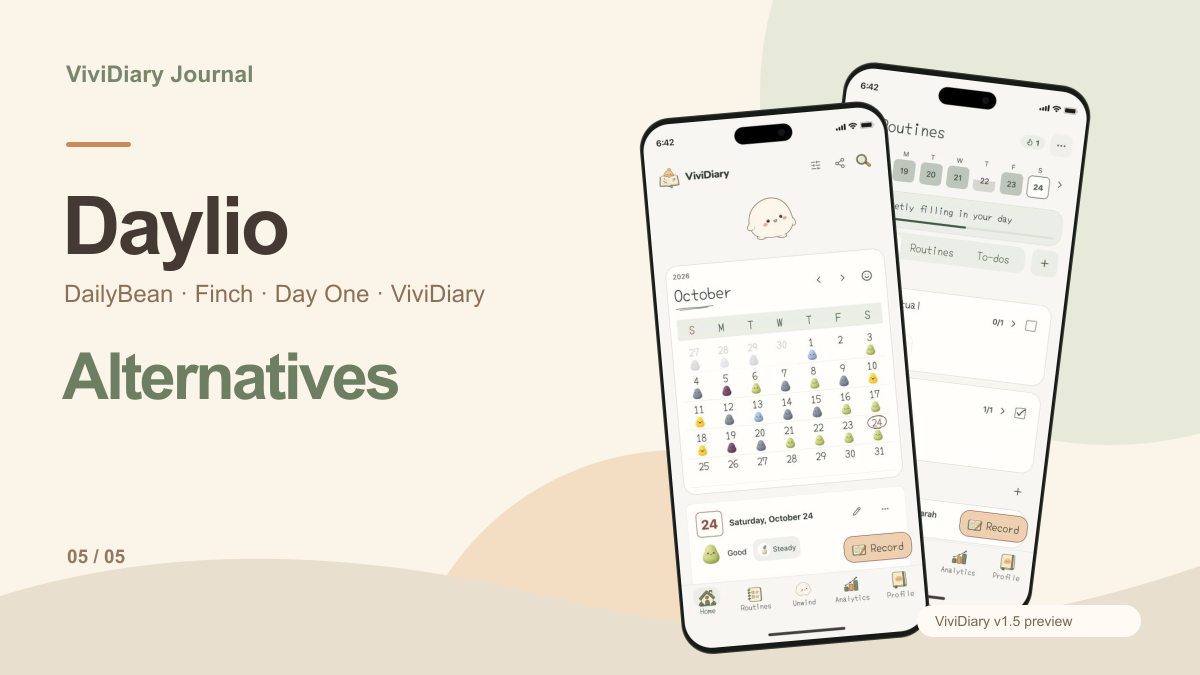
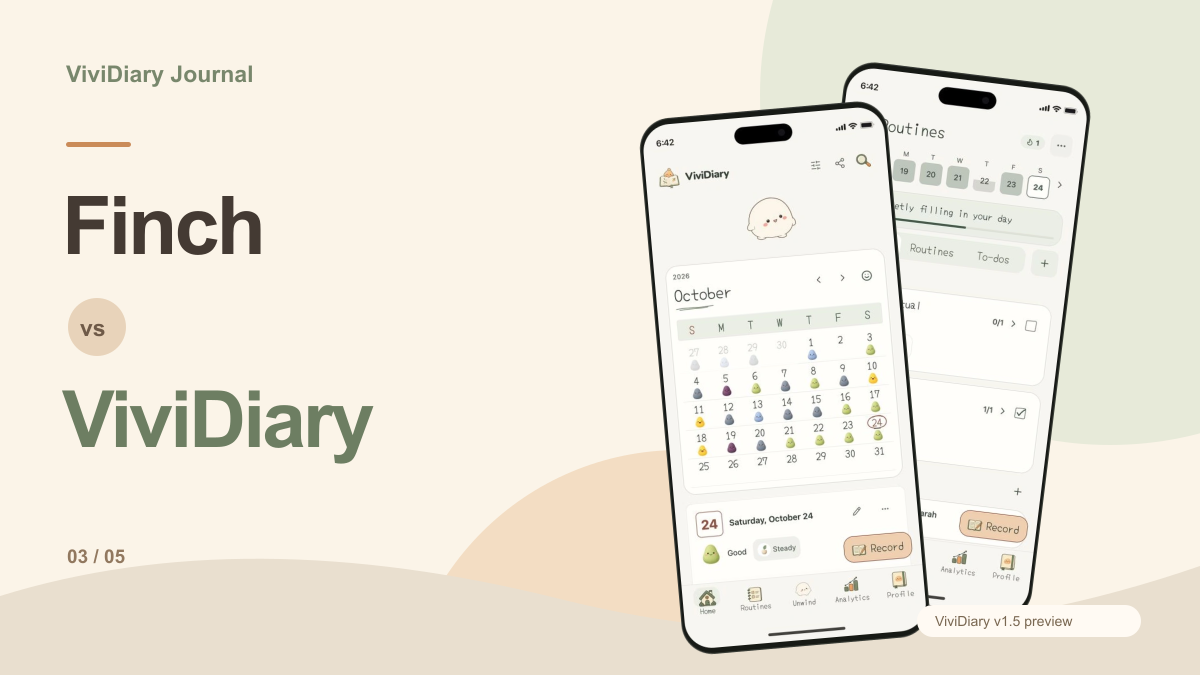
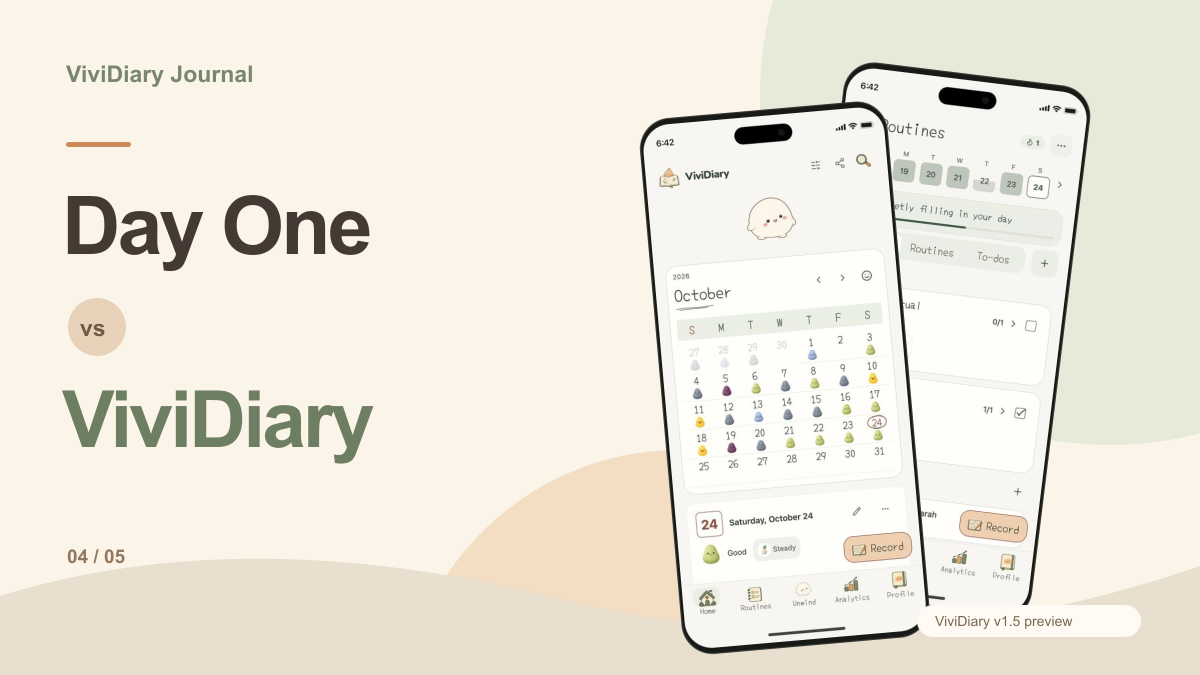
If Finch's daily demands started to feel like a guilt trip, ViviDiary is designed to be the exact opposite. Positioned as "your day, in moods, emojis, and patterns," ViviDiary is a privacy-first tracker built entirely around user agency.

The Feature Breakdown What makes ViviDiary stand out among best mood tracker apps for adults is its modularity. When you download the app, almost everything is turned off. The only required input is your Mood (a simple 5-level scale: Great, Good, Okay, Low, Rough). Everything else—memos, photos, voice notes, and 22 manual emoji modules—is opt-in.
For recovering Finch users, ViviDiary's approach to goals (called "Focus") is a breath of fresh air. Focus is split into Routines (things you want to notice and keep up) and Todos (one-off daily tasks). There are no pressure-style streaks. You will never see a traffic-light progress UI, a completion percentage, or receive a notification designed to make you feel guilty for missing a day. The app auto-counts matching check-ins and links them to mood patterns in your weekly "Mirror" review, strictly for observation.
Privacy and Tech ViviDiary operates on a privacy-first architecture. Data is cloud-stored via Supabase to ensure your archives are safe, but any diary text is completely de-identified before external or AI processing. The AI itself is purely an optional supporting tool for days you want to dig deeper—it never creates content without your input or pressures you into achieving goals.
Who Should Choose ViviDiary * Users seeking apps like finch but simpler without the pet-care overhead. * People who experience "streak anxiety" and want low-demand tracking. * Those who want a budget-friendly premium tier ($2.99/mo or $11.99/yr) without losing core functionality on the free plan.
Daylio: Best for Pure Micro-Journaling
Daylio is the veteran of the micro-journaling space, and it remains one of the most reliable finch app alternatives for adults who want speed above all else.
The Feature Breakdown Daylio requires zero writing. You pick your mood from a customizable set of icons, tap the activities you did that day (e.g., "reading," "good meal," "bad sleep"), and you are done. Over time, Daylio cross-references your activities with your moods to show you statistical correlations—like the fact that your mood dips on days you skip your morning walk.
While Daylio does have some gamification in the form of "streaks" and achievement badges, it lacks the virtual economy of Finch, making it feel much more like a utility than a game. We have previously explored how Finch compares to Daylio for ADHD, noting that Daylio's speed is a massive advantage for neurodivergent users who struggle with complex daily logs.
Pricing Daylio operates on a freemium model. The free version is highly functional, but to unlock advanced stats, unlimited moods, and automatic backups, you will need Premium, which runs about $4.99/month or $35.99/year.
Who Should Choose Daylio * Data enthusiasts who love charts, graphs, and statistical correlations. * Users who want a check-in process that takes less than 10 seconds. * People who don't mind light streak-based gamification.
How We Feel: Best for Emotional Granularity
If your main issue with Finch was that "Good" or "Bad" didn't accurately capture your complex adult emotions, How We Feel is the scientific antidote.

The Feature Breakdown Built in collaboration with Yale University researchers, How We Feel is a masterclass in emotional granularity. Instead of a basic 5-point scale, the app divides emotions into a color-coded grid based on energy (high/low) and pleasantness (positive/negative). You don't just log that you feel "bad"—you pinpoint whether you feel drained, alienated, or apprehensive.
How We Feel is entirely devoid of gamification, streaks, or virtual pets. It is a pure, clinical, and beautifully designed tool for self-awareness. It also includes somatic tracking, allowing you to note physical sensations alongside your emotional state. It regularly ranks at the top of our lists for anti-optimization wellness apps because it asks nothing of you other than honesty.
For a deeper dive into the clinical side of tracking, check out our detailed comparison of Daylio and How We Feel.
Pricing How We Feel is 100% free. No paywalls, no premium subscriptions, no ads. It is funded by a nonprofit, which is a rarity in 2026.
Who Should Choose How We Feel * Users who struggle to name their emotions and want a guided, research-backed vocabulary. * Anyone looking for a completely free tool with zero paywalls. * People who want absolutely zero gamification.
Habitica: Best for RPG-Style Productivity
What if you didn't outgrow Finch because of the gamification, but because the gamification wasn't intense enough? Enter Habitica.
The Feature Breakdown Habitica is a habit tracker built like a retro 16-bit role-playing game. Instead of taking care of a cute bird, you are building a warrior, mage, or rogue. When you complete your real-world tasks, your character gains experience points and gold to buy armor. When you fail to complete your daily habits, your character takes damage.
Habitica allows you to join "parties" with other real users to fight boss monsters. If you skip your habits, the boss damages your entire party. It is high-stakes, highly social, and requires a significant amount of setup. It is the furthest thing from "low-demand," but for a specific type of brain, that accountability is exactly what works.
Pricing Habitica is free to use, with an optional $4.99/month subscription that offers exclusive cosmetic items and the ability to buy gems with gold.
Who Should Choose Habitica * Gamers who respond well to RPG mechanics, stats, and high-stakes accountability. * Users who want social pressure (in a fun way) to complete their habits. * People who view their daily tasks as a quest list rather than a gentle routine.
The Verdict: Which Tracker Fits Your Brain?
Graduating from a virtual pet tracker doesn't mean you have to default to a boring spreadsheet. The best mood tracker apps for adults in 2026 understand that different brains require different systems.
* Choose ViviDiary if you want the ultimate low-pressure environment. Its modular, emoji-based system and complete lack of streak-guilt make it the healthiest choice for users who easily burn out on daily tracking.
* Choose Daylio if you want speed and data. It remains the king of the 10-second micro-journal.
* Choose How We Feel if you want to understand the exact nuance of your emotions, completely free of charge.
* Choose Habitica if you want to turn your life into a video game with real consequences for missing your daily tasks.
Take a week to test the one that sounds most aligned with your current mental bandwidth. The best app isn't the one with the most features; it's the one you don't dread opening.