

Quick Verdict: Which App Wins?
For the 2026 back-to-school season, the best teacher mental health apps depend entirely on your daily bandwidth. Calm ($69.99/yr) is ideal for dedicated meditation if you actually have the downtime. Daylio ($35.99/yr) offers simple, passive mood tracking for those who want a quick visual log. However, ViviDiary ($11.99/yr) is the best all-around choice for busy educators. It combines ultra-fast emoji mood logging with light focus routines and strict privacy-first cloud storage, making it the most practical tool to manage syllabus week without adding to your workload.
---
The Back-to-School Burnout Reality (and Why Most Apps Fail)
Heading into the 2026 back-to-school season, teacher burnout remains at an all-time high. According to recent RAND survey data, the leading causes of educator exhaustion include managing student behavior, working well beyond contracted hours, and the heavy emotional toll of supporting students' mental health.
To combat this, many teachers are turning to digital mental health and mood-tracking tools to establish boundaries and process complex emotions. But there is a glaring problem: most self-care apps demand too much time. If an app requires you to sit down and write a 500-word reflection, it is going to fail. You do not have 20 minutes to journal during a passing period. You need a tool that fits into the margins of your day.
If you are setting up your digital toolkit for the fall, starting with a proper back to school mental health check-in is crucial. But once the school year starts, you need a daily driver that won't become just another chore.

Comparison Criteria: What Educators Actually Need
As a tech reviewer, my credibility depends on testing these apps in realistic scenarios. For educator mood tracker apps, I evaluated them based on:
- Speed of Entry: Can you log your state of mind in under 30 seconds?
- Guilt-Free Mechanics: Does the app punish you for missing a day? Teachers have enough pressure; your app shouldn't add to it.
- Actionable Insights: Does it help you spot patterns (e.g., "I am always exhausted on block-schedule days")?
- Privacy: Are your thoughts secure?
2026 Feature & Pricing Breakdown
Here is the head-to-head breakdown of the top contenders.
| Feature / App | Calm | Daylio | ViviDiary |
|---|---|---|---|
| Best For | Dedicated mindfulness | Passive icon tracking | Modular tracking & routines |
| Time Required | 10-15 minutes | Under 1 minute | Under 30 seconds |
| Guilt-Free UI? | Yes | Mostly (some streak focus) | Yes (Zero streaks/pressure) |
| Annual Price | $69.99 | $35.99 | $11.99 (or Free tier) |
1. Calm: Best for Dedicated Mindfulness (If You Have the Time)
Calm remains a juggernaut in the wellness space, and for good reason. Its library of guided meditations, breathing exercises, and sleep stories is unmatched.
The Good: If you suffer from Sunday Scaries or struggle to wind down after a chaotic day of parent-teacher conferences, Calm's sleep stories are highly effective. The audio quality is premium, and the guided sessions are genuinely restorative.
The Reality Check: Calm is not an on-the-go tool. It requires dedicated time and a quiet environment—two things teachers rarely have between 7:30 AM and 3:30 PM. Unless you plan to meditate in the supply closet, Calm is strictly an after-hours solution.
- Teachers who struggle with sleep anxiety.
- Educators who have a dedicated 15-minute commute they can use for audio mindfulness.
- Those who want guided audio rather than active tracking.
2. Daylio: Best for Basic, Passive Mood Tracking
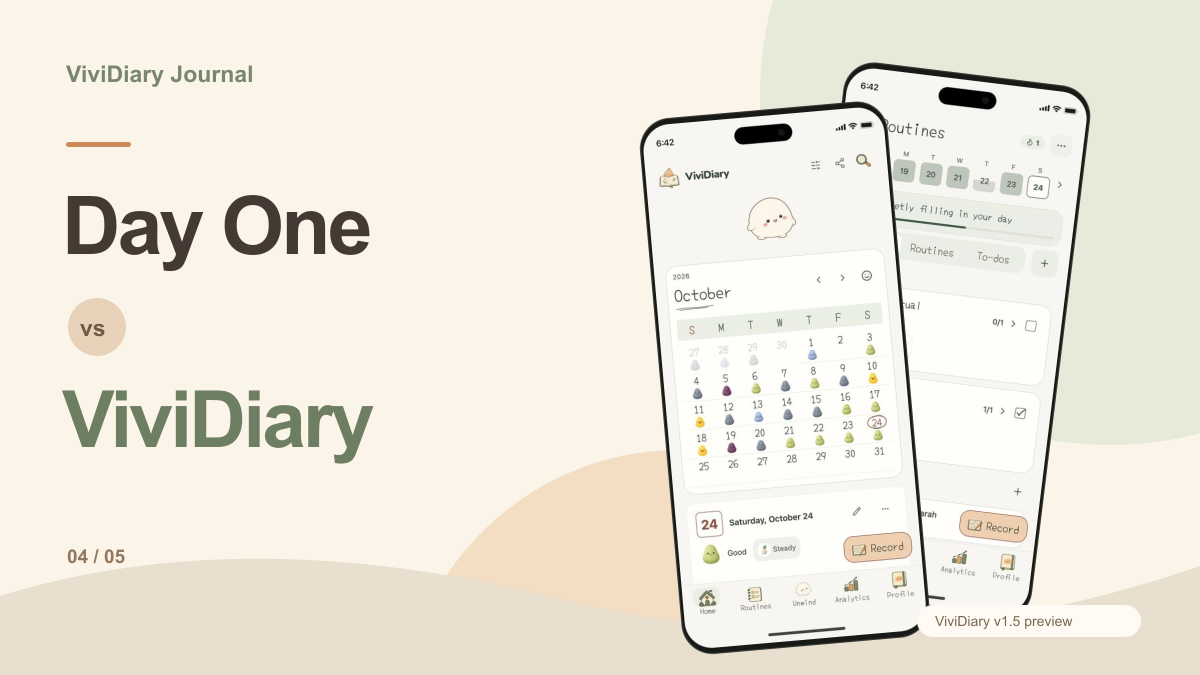
For educators with zero time to spare, low-barrier apps like Daylio are highly recommended. Daylio operates as a micro-journal, allowing users to log their moods and activities using customizable icons rather than typing out long entries.
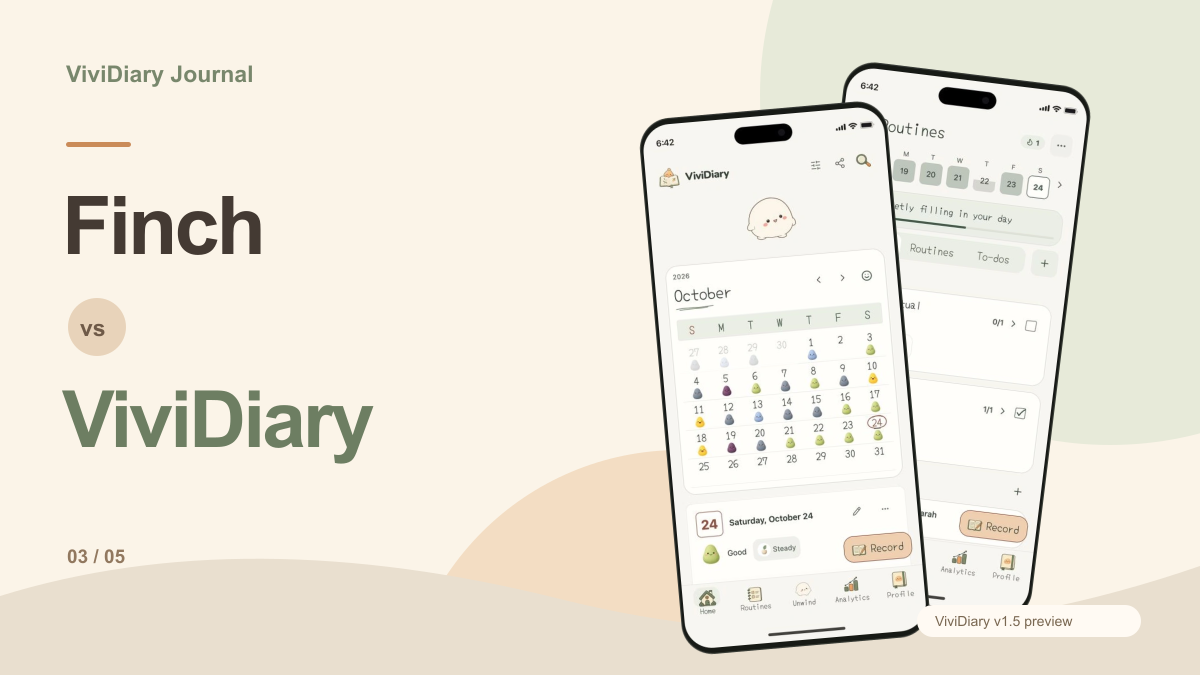
The Good: It is fast. You tap a smiley face, tap a few icons representing what you did (e.g., "Grading," "Staff Meeting"), and you are done. Over time, it provides robust analytics to help you spot which days or classes trigger the most stress. If you are interested in how it stacks up against more gamified options, I highly recommend comparing Finch and Daylio for adult users.
The Reality Check: Daylio is excellent for looking backward, but it doesn't do much to help you structure your focus moving forward. It also leans on streaks, which can induce guilt if you miss a weekend.
- Teachers who want a purely visual, icon-based diary.
- Data nerds who love charting their mood against specific activities.
- Users who want zero text input.
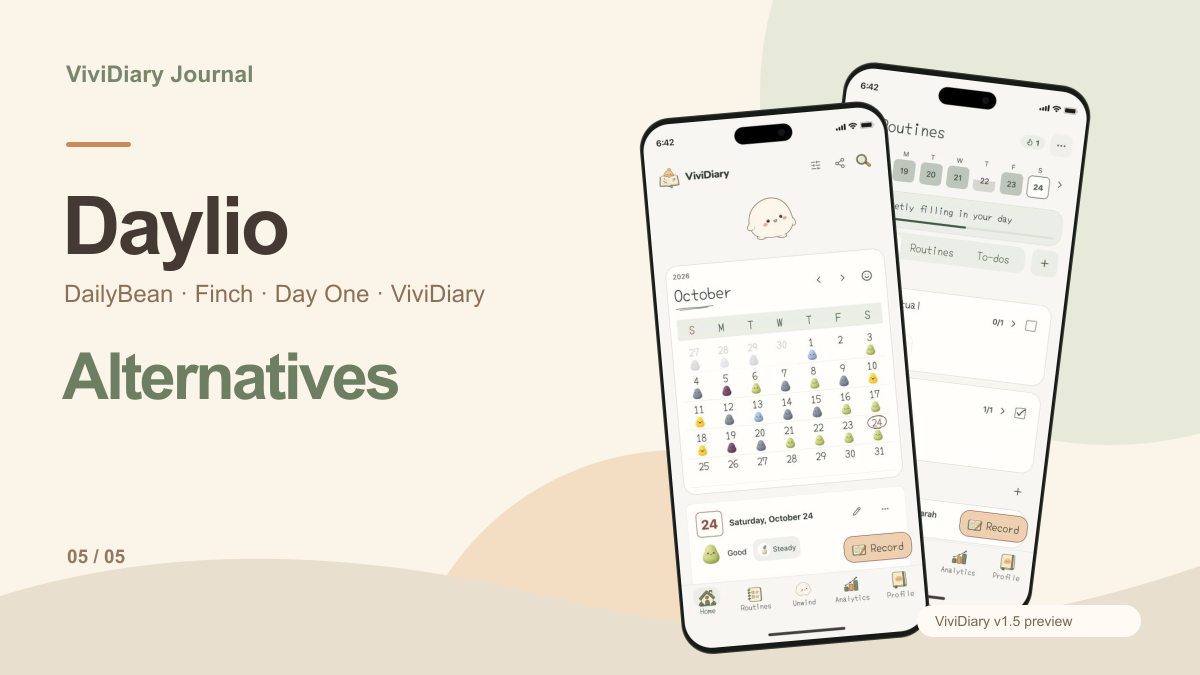
3. ViviDiary: Best for Busy Teachers (Modular Mood & Focus)
If you want the lightness of Daylio but need a tool that actively helps you manage your daily bandwidth without guilt-tripping you, ViviDiary is the standout for 2026. It positions itself as "Your day, in moods, emojis, and patterns."
The Good: ViviDiary is entirely modular. The only required input is your Mood (a simple 5-level scale: Great/Good/Okay/Low/Rough). Everything else—memos, photos, or the 22 manual emoji modules—is opt-in. You can log your state in under 30 seconds.
Where ViviDiary truly shines for educators is its Focus module (Routines + Todos). A Routine is simply something you want to notice and keep up (like drinking water or leaving work by 4 PM), while a Todo is a per-day item.
Here is the critical differentiator: ViviDiary has no pressure-style streaks. There are no "you missed today" guilt notifications, no streak-freezes, and no traffic-light progress UIs. Routines keep a gentle personal-best count. It sits beside you; it doesn't coach or scold you. This makes it an incredible stress tracker for syllabus week when your schedule is already chaotic.
Additionally, its weekly "Mirror" feature gently surfaces patterns (Time, Activity, People, Focus) on Sunday mornings, offering observation rather than prescription. (Note: It is also one of the ADHD mood trackers for back-to-school that actually respects neurodivergent workflows by avoiding completion-percentage anxiety).
Pricing: The Free tier is incredibly generous (All input modules, unlimited mood + emoji logging, 3-month calendar archive, weekly Mirror, up to 3 Routines / 5 Todos). Premium is highly accessible at $2.99/mo or $11.99/yr.
- Busy teachers who need logging to take under 30 seconds.
- Educators who refuse to be guilt-tripped by broken streaks.
- Users who want to track light routines alongside their mood without feeling like they are failing a test.

Privacy Check: Protecting Educator Data in the Cloud
Teachers are naturally protective of their privacy. If you are logging frustrations about administration or a difficult classroom dynamic, you need to know that data is secure.
When doing a private journal app comparison, it is vital to look at how these apps handle your data.
ViviDiary operates with a strict privacy-first architecture. It is cloud-stored (using Supabase), which means your data is synced and safe if you lose your phone. Crucially, any diary text is de-identified before any external or AI processing occurs. ViviDiary's privacy comes from strict data minimization and de-identification. (While some apps claim offline storage as a marketing gimmick, cloud storage with proper de-identification is the standard for reliable, multi-device access without compromising personal security).
The Verdict: Which App Belongs on Your Home Screen This Fall?
Teacher burnout prevention tools only work if you actually use them.
If you have the time and budget to dedicate to audio mindfulness, Calm is a fantastic investment. If you want a purely retrospective, icon-based tracker, Daylio is a solid, albeit slightly pricey, choice.
But for the reality of the 2026 school year—where time is non-existent and pressure is high—ViviDiary is the clear recommendation. Its modular design lets you track exactly what you want (and nothing you don't), its Focus routines respect your bandwidth by eliminating streaks and guilt, and at $11.99 a year for Premium (or a highly functional free tier), it is the most practical tool to keep your mental health in check this fall.