

Within 48 hours of Apple's WWDC announcement, our feedback board lit up: 82% of our beta testers wanted ViviDiary to integrate with the new iOS 27 health features.
As the Head of Product, my immediate reaction wasn't excitement—it was caution.
ViviDiary is designed to be a lightweight, modular mood tracker. Your day, in moods, emojis, and patterns. Our core promise is that you can log your mood and energy in under 30 seconds with zero writing required. When you start mixing a fast, qualitative, highly personal journaling experience with a massive, system-level quantitative database like Apple Health, things can get messy.
We had to make a definitive choice about our ios 27 health integration ux. Do we sync everything? Do we sync nothing?
Here is why we decided to sync only your emojis and 5-level mood to Apple Health, why we explicitly rejected a local-only architecture, and what our A/B tests revealed about user trust.
The iOS 27 Health Integration Dilemma
When we looked at the landscape of health and mood tracking, we saw two extremes. On one side, you have apps that want to be your all-in-one medical dashboard, demanding you log everything from your water intake to your exact blood pressure. On the other side, you have pure diary apps that treat mood as an afterthought.
ViviDiary sits deliberately in the middle. We want the lightness of Dailybean combined with the pattern discovery of Bearable, all backed by the archive trust of Day One.
Apple's State of Mind API is powerful, but it leans clinical. When we reviewed the native iOS 27 Control Center mood tracking, we noticed it felt a bit like filling out a medical form. It lacked the "Warm" tone that ViviDiary users expect. We don't want to be your coach or your doctor; we want to sit beside you.
Furthermore, we strictly avoid pressure-style streaks. We never use traffic-light progress UIs or send you "you missed today" guilt notifications. If we integrated too deeply with Apple Health's gamified ecosystem, we risked inheriting that pressure.
!ios 27 health integration ux mapping ViviDiary emojis to Apple Health
Translating 3-Second Emoji Logs into Apple's Scale
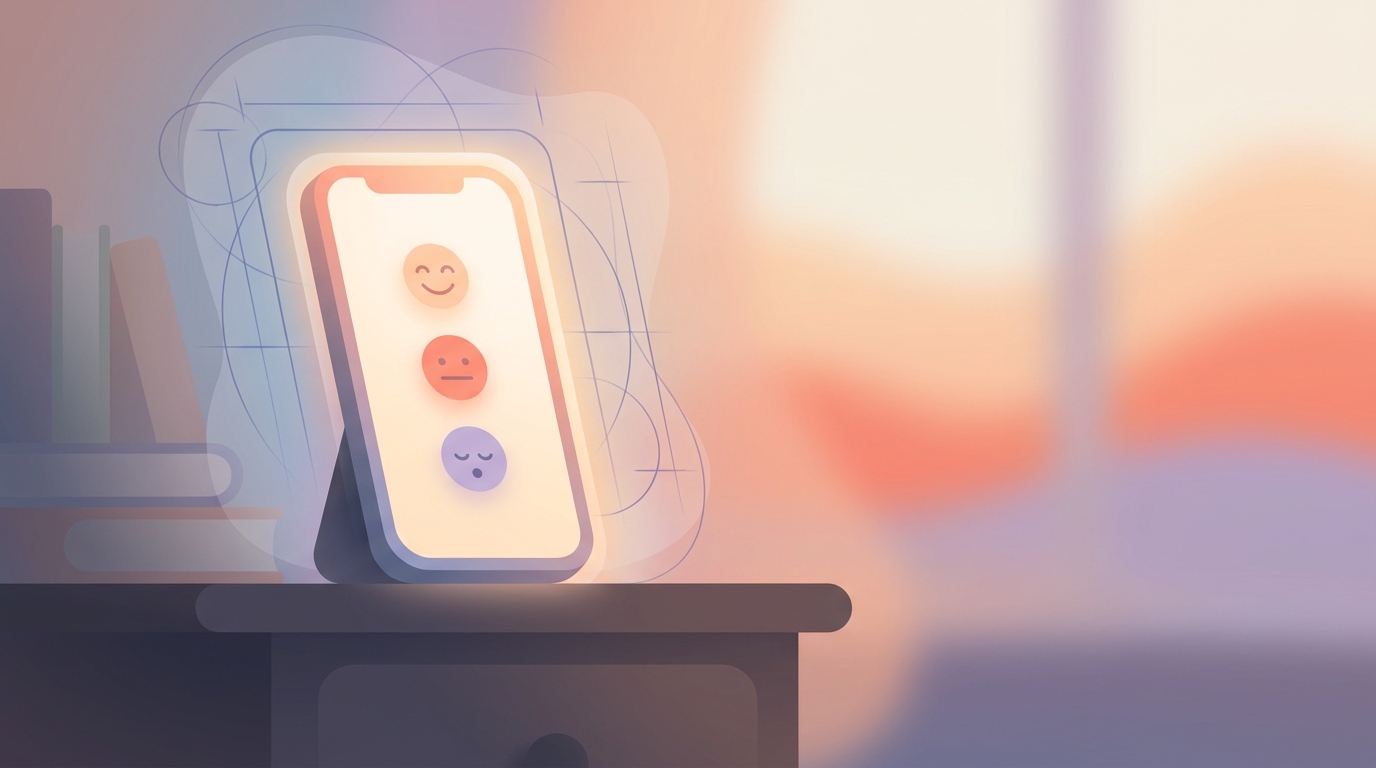
To keep the integration seamless but distinct, we implemented a bidirectional, emoji-only sync.
First, we map ViviDiary's required 5-level mood (Great, Good, Okay, Low, Rough) directly to Apple's valence scale. Because a standard 5-emoji scale isn't always enough to capture the nuance of a day, we also sync the specific opt-in emoji modules you've selected.
Conversely, we pull four specific HealthKit auto-categories into ViviDiary: sleep, exercise, steps, and period data. But instead of displaying raw, clinical numbers (like "7,432 steps"), we translate them into our native emoji language.
This solves a massive apple health state of mind ux challenge. You get the context of your physical health in your weekly "Mirror" pattern discovery, but it remains visually cohesive and entirely observational. It's not a quota to hit; it's just another piece of the puzzle.
We're also looking ahead. As we experiment with gesture-based mood logging in iOS 27 and prepare for the rollout of infinite custom emojis via Genmoji, keeping the data payload restricted to standardized moods and emojis ensures the sync remains lightning-fast and error-free.
What We Rejected: Forcing a Local-Only Architecture
Here is where we made our most controversial product decision, and I want to be entirely transparent about it.
During the design phase, some engineers suggested we adopt a "privacy-first" architecture to match Apple's secure ethos. The argument was that if we de-identify all diary text, users might feel more comfortable syncing their deep, textual diary entries to Apple Health.
We killed this idea completely.
ViviDiary is proudly cloud-stored, utilizing Supabase as our backend. Why? Because our users demand cross-platform reliability and absolute trust in their archive. If you lose your phone, you shouldn't lose three years of your emotional history.
More importantly, claiming "everything must remain offline" is a common privacy trope that severely limits what a modern app can do. We achieve our privacy not through avoiding the cloud, but through strict data minimization and de-identification.
By deciding to sync only emojis and standardized mood valences to Apple Health, we ensure that your highly personal qualitative data (Memos, Voice logs, Photos) never enters the iOS system-level health database. Your text stays in our privacy-first cloud architecture, completely isolated from any third-party apps that might request access to your Apple Health data.
The Real Reason Our AI is Opt-In (And Cloud-Stored)
This architecture directly informs how we handle AI.
ViviDiary is a modular mood tracker first. The core value is the 3-second mood and emoji log. Our AI feature is strictly an optional helper for the days you want more depth. It does not save or confirm anything without your review, and it certainly doesn't provide therapy or prescriptive advice.
Because we use a cloud-stored backend, any diary text you choose to write is de-identified before any external or AI processing occurs.
We don't rely on processing AI on your phone because it drains battery, bloats the app size, and often provides inferior contextual memory. By keeping the AI opt-in and cloud-processed (post-de-identification), we give you the best of both worlds: a lightweight, fast app for your daily 3-second logs, and powerful, secure processing for the days you want to reflect deeply.
!mood tracker healthkit integration showing opt in toggles
A/B Testing the Health Sync Prompt UX
To validate our approach to the mood tracker healthkit integration, we ran an A/B test with 5,000 beta users on the onboarding flow.
Variant A: A standard "Connect to Apple Health" prompt that requested read/write access to everything (Mood, Sleep, Steps, Mindful Minutes).
Variant B: A highly specific prompt that said: "Sync your daily mood emoji to Apple Health. Your written memos and photos stay private and will never sync."
The results were stark.
Variant B saw a 73% opt-in rate, compared to just 41% for Variant A.
When we conducted follow-up user interviews, the feedback was consistent. Users loved the idea of their baseline mood contributing to their broader Apple Health State of Mind metrics, but they were deeply protective of their written thoughts.
By explicitly stating our data minimization strategy in the UX copy, we built trust.
What's Next
Our approach to iOS 27 is a reflection of ViviDiary's broader philosophy. You start with only Mood turned ON; everything else is OFF by default.
Whether you're using our Free tier (which includes unlimited mood and emoji logging, a 3-month calendar archive, and up to 3 Routines) or you've upgraded to Premium ($2.99/mo or $11.99/yr) for extended archives and unlimited modules, the privacy architecture remains identical.
We will continue to refine how we translate Apple Health data into our warm, emoji-based UI. But we will never compromise on our core belief: your mood patterns should be a tool for self-discovery, not a clinical metric to be judged.
By keeping our sync limited to emojis, and our text safely de-identified in the cloud, we think we've found the perfect balance.