
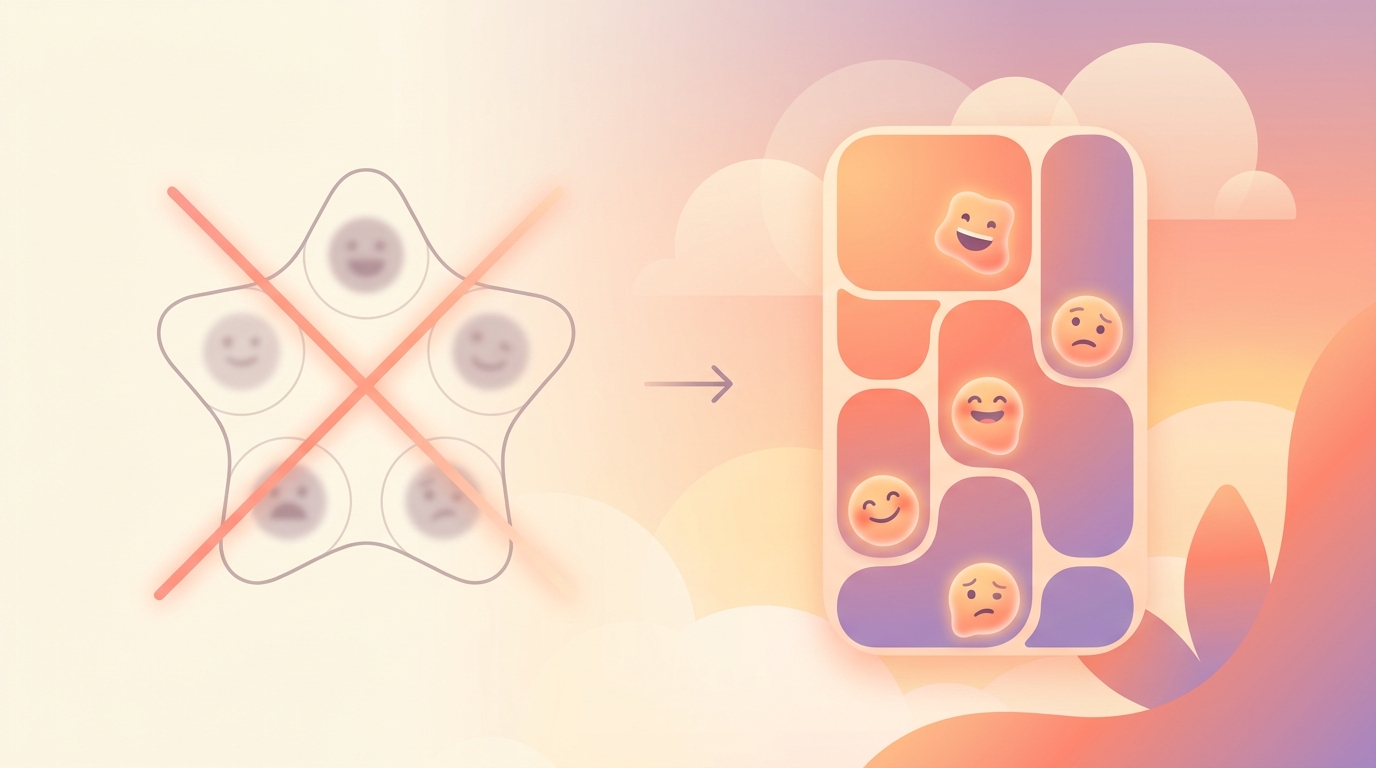
We killed the traditional 5-point emoji scale because it was lying to us.
When we looked at the data from our early beta at ViviDiary, we noticed a glaring anomaly. On days when users were logging high levels of stress or low sleep via Apple HealthKit, their mood logs were overwhelmingly defaulting to the neutral "Meh" face (😐).
Were they actually feeling neutral? No. When we conducted user interviews, the truth came out: "Meh" had become a dumping ground for emotional chaos. Users were feeling overwhelmed, overstimulated, or exhausted, but a simple sad face (😢) didn't accurately capture that complexity.
Traditional 5-point mood scales fail to capture complex modern emotions. By switching to a modular emoji system, ViviDiary allows users to log their mood using expressive, nuanced icons—like the highly anticipated 2026 Distorted Face emoji (). This product decision increased our daily retention by letting users accurately capture chaotic feelings in under three seconds. For users who want more depth, our optional AI helper builds on these emojis, with all data secured via de-identified cloud storage on Supabase, ensuring privacy through data minimization.
Here is the inside story of why we ripped out the industry standard, what we tried instead, and how distorted face emoji mood logging changed our product trajectory.
The Problem with "Good, Meh, Bad"
The old paradigm of mood tracking assumes human emotion is a straight, linear spectrum from 😡 (Angry) to 😄 (Happy).
But what if you are exhausted but proud? Anxious but excited? Overstimulated and shutting down?
Our initial UI forced users to pick a single yellow circle to summarize their entire 24-hour human experience. It created massive friction. Users would stare at the screen for 15 seconds, experience decision fatigue, and either close the app or tap the neutral face just to get it over with.
We realized that forcing a distressed or exhausted user to categorize complex feelings into a generic bucket increases executive burden. Industry research on designing for distressed users consistently shows that dense, prescriptive tracking dashboards overwhelm the very people they are trying to help. We needed to be lighter, faster, and far more expressive.
Enter the Distorted Face: Designing for 2026's Emotional Chaos
Modern emotions are messy. When we looked at the cultural resonance of the new emojis 2026 mood tracking trends—specifically the introduction of the Distorted Face emoji ()—it clicked. People don't just feel "sad." They feel distorted, stretched thin, and chaotic.
We decided to decouple mood baseline from emotional expression.
Instead of a 5-point emoji scale, we built a hybrid system. Mood is now the only required input in ViviDiary, and it uses a simple, name-based 5-level baseline: Great, Good, Okay, Low, Rough.
Once you tap a baseline, you are presented with our highly modular emoji system featuring 22 manual categories. You can log a "Rough" day and pair it with the Distorted Face emoji (), a Tornado (🌪️), and a Battery Low (🪫) icon.
This completely transformed the emoji mood tracker ux. Users could now accurately log a chaotic day in under 30 seconds without writing a single word. New users start with only the Mood module ON and everything else OFF, ensuring the app remains exceptionally light by default.
What We Rejected: The Clinical 10-Point Scale
Before we landed on the modular emoji system, we went down a different path: The 10-point scale.
We hypothesized that if 5 points weren't enough, 10 points would give users the granularity they craved. We built a prototype that looked much like a clinical hospital pain scale, ranging from 1 to 10.
It was a disaster.
In our A/B tests, the 10-point scale increased average check-in time from 28 seconds to 45 seconds. Worse, dropout rates on the logging screen spiked by 18%.
When you are having a "Rough" day, trying to logically deduce whether your anxiety is a 3 or a 4 is exhausting. It turns self-reflection into a math test. We quickly killed the 10-point scale. We learned that users don't want numerical granularity; they want expressive granularity. They want a distorted face emoji mood logging experience that visually validates how they feel.
How We Map Chaotic Emojis to Habit Analytics
The goal of a modular mood/life tracker isn't just to log isolated emotions; it's to discover meaningful patterns. But how do you quantify a Distorted Face emoji?
We rely on our Mirror feature, which delivers insights weekly (Sunday mornings) and on-demand. Mirror connects the dots between your moods, your opt-in emoji tags, and auto-imported HealthKit data (sleep, exercise, steps).
Crucially, we do this without ever using pressure-style streaks.
In ViviDiary, our Focus module consists of Routines and Todos. A Routine is simply something you want to notice (like "Morning Walk"), and a Todo is a per-day item. Neither is a pressure quota. We actively reject panic-inducing streak freezes, completion percentages, traffic-light progress UIs, and guilt-inducing "you missed today" notifications.
If you log the Distorted Face emoji frequently on days you skip your "Morning Walk" routine, Mirror gently points out the pattern in a "Warm (따뜻하게)" tone. It acts as a supportive companion, not a demanding coach.
(Note on access: Our Free tier includes all input modules, unlimited mood + emoji logging, a 3-month calendar archive, weekly Mirror, and up to 3 Routines / 5 Todos. For users who want unlimited Focus items and deeper historical archives, our Premium tier is $2.99/mo or $11.99/yr).
Why AI is Opt-In (and How We Handle Cloud Privacy)
With the rise of AI, many apps are pivoting to become "AI Journals" that automatically write your entries or diagnose your feelings. We explicitly chose not to do this.
Our core value is the 3-second mood and emoji log. Zero writing required.
However, for the days a user wants more depth—perhaps they want to explore why they logged that Distorted Face—our AI acts as an optional supporting tool. It helps draft thoughts through conversation, but it never saves or confirms anything without user review, and it never provides therapy or prescriptive advice.
When dealing with vulnerable emotional data, privacy is paramount. We protect your information through strict data minimization and by de-identifying your entries before any external processing.
For ViviDiary, that is not our architecture, and we believe in being transparent about it.
ViviDiary's data layer is cloud-stored using Supabase. Our privacy guarantee comes from strict data minimization and de-identification. Before any diary text touches our external AI processing layers, it is thoroughly de-identified. We strip out PII (Personally Identifiable Information) so the AI only sees the emotional context, not the identity behind it. This allows us to provide powerful, cross-device syncing and reliable cloud backups while maintaining a privacy-first architecture.
The A/B Test: Why Expressive Logging Wins
When we rolled out the hybrid baseline + modular emoji system to a wider cohort, the data validated our decision to kill the 5-point scale.
Here is what we saw in the first 30 days:
* Check-in Time: Remained stable at an average of 26 seconds. We added expressive depth without adding time friction.
* Negative Emotion Capture: Logs categorizing days as "Low" or "Rough" increased by 31%. Users finally felt they had the right tools (like the new emojis 2026 mood tracking set) to express bad days without defaulting to "Meh."
* D30 Retention: Increased by 24% among users who previously churned after logging a string of bad days.
By allowing users to lean into the chaos of a distorted face emoji mood logging session, we made the app a safer, more accurate place for their actual feelings.
What's Next
We are currently expanding the Mirror feature (V1.5) to better analyze the "External" domain—how factors outside your control correlate with your expressive emoji usage.
We are also continuing to monitor the Unicode Consortium's upcoming releases. As human expression evolves, so will our modular emoji categories. We will never go back to a linear scale. Human emotion is far too interesting for that.